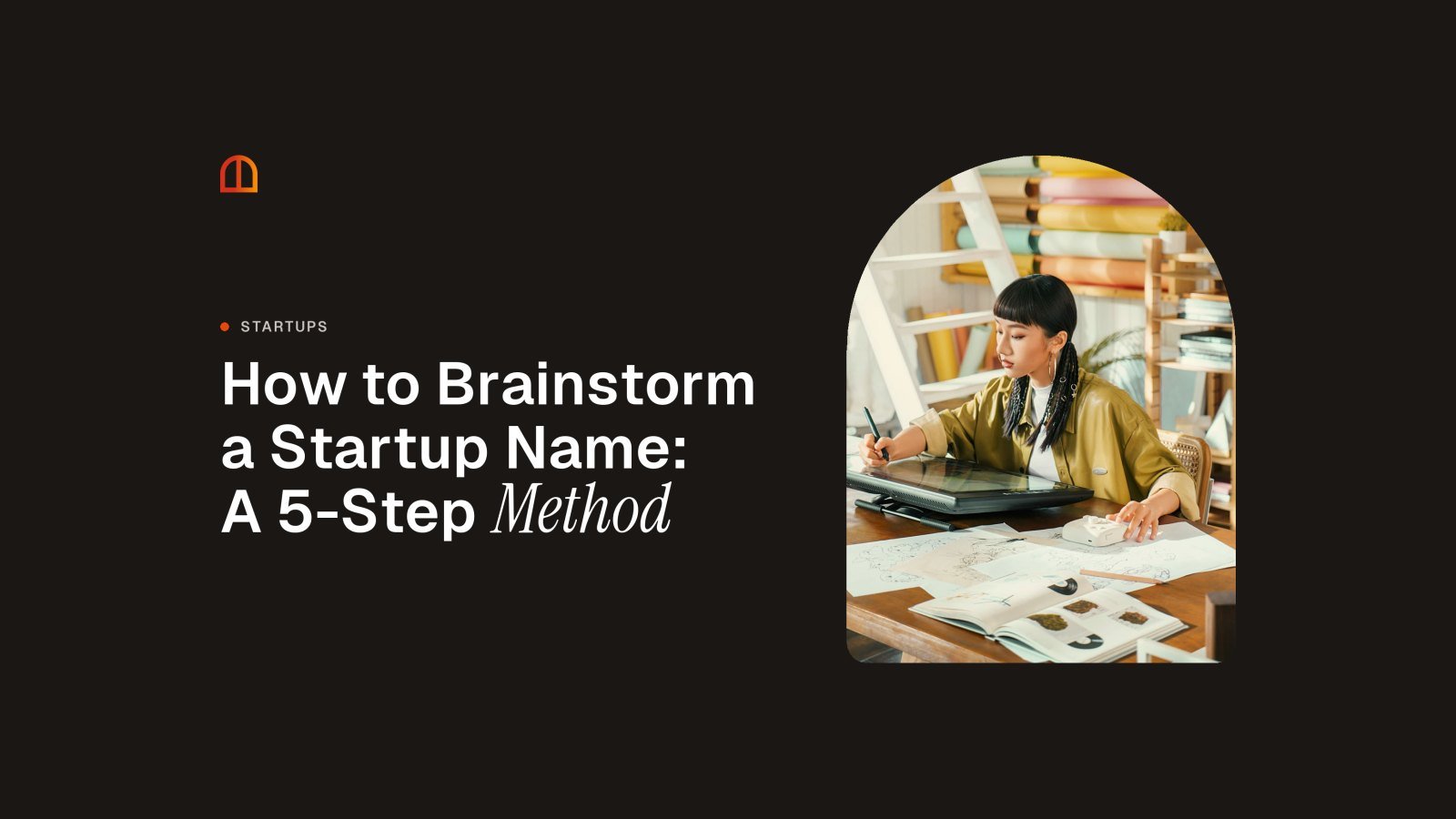
To brainstorm a startup name, start with what you stand for and who you sell to, then generate a long list across five naming types (descriptive, suggestive, compound, invented and abstract). Cut it down with a simple scoring table, check trademarks, domains and social handles before anyone falls in love with a name, and test the last three or four with real buyers. A good name is clear enough to remember, distinct enough to own, and easy to say and spell.
Key takeaways
- Write your positioning before you write any names. The name should fit it.
- Aim for quantity first: 50 to 100 options before you judge any of them.
- Check trademarks and domains early, not after the logo is designed.
- Score finalists on the same criteria so the loudest opinion doesn't win.
- Test with buyers: can they remember it, spell it and guess what you do?
Why your startup name matters (and what it can’t do)
Your name is often the first thing a buyer meets: in a referral, a search result, an investor email or an app store listing. It shapes whether people remember you, can find you again, and trust you enough to click.
What a name can’t do is carry a weak product or vague positioning. Plenty of strong companies have plain names, and some memorable names never found customers. Treat naming as removing friction (hard to spell, easy to confuse, impossible to trademark), not as a magic growth lever.
Myth vs fact
- MythThe right name will make customers convert.
- FactA name removes or adds friction. Positioning, product and proof do the converting. Pick a name that doesn't get in their way.
- MythYou should only check availability once you've chosen.
- FactCheck early. Falling for a name you can't register or trademark wastes weeks and money.
- MythShort invented names are always better.
- FactInvented names are easier to own but cost more to explain. Descriptive names are clear but hard to protect. The right choice depends on your budget and market.
Step 1: define what you stand for before naming your startup
Answer three questions in writing:
- Who is the buyer? A name that works for enterprise IT leaders may not work for Gen Z consumers. Describe your target audience in one sentence.
- What do you promise? Write your value proposition in one line. The name should hint at it or at least not contradict it.
- How do you want to be seen? Pick three adjectives a customer would use about you, for example “secure, modern, borderless” for a fintech or “efficient, clear, dependable” for B2B software.
Then place yourself on four positioning dimensions:
| Dimension | One end | Other end |
|---|---|---|
| Price | Premium | Accessible |
| Buyer | B2B, credibility first | B2C, personality first |
| Category | Follows conventions | Challenges them |
| Market | Local, can use local language | Global, must travel across languages |
If you’re building in Lagos for Nigerian customers, a name with local meaning can be a strength. If you plan to sell in the US and UK as well, test that it’s easy to say and spell for those buyers too.
Step 2: generate startup name ideas with five naming types
Use the five types as prompts so your list isn’t 50 versions of the same idea.
| Naming type | What it is | Examples | Strengths | Trade-offs |
|---|---|---|---|---|
| Descriptive | Says what you do | General Motors, American Airlines | Instantly clear | Hard to trademark, can feel generic |
| Suggestive | Hints at the benefit | Pinterest, Shopify | Memorable and still meaningful | Can need a line of explanation |
| Compound | Two words joined | Facebook, YouTube, Paystack | Familiar but distinct | Domains often taken |
| Invented | A new word | Spotify, Zillow | Easy to own across markets | Needs marketing to give it meaning |
| Abstract | A real word used out of context | Apple, Amazon | Distinctive, flexible | The link to your product has to be built |
Brainstorming techniques that work
- Mind map. Put your core idea in the middle and branch out to benefits, feelings and images. For a health product: wellness, vitality, balance, pulse.
- Word association. List industry words in one column and outcome or emotion words in another, then combine across columns.
- Synonym chains. Follow a word through synonyms of synonyms: fast, swift, fleet, nimble. Each step opens new territory. Check antonyms too.
- Borrow from other languages. Look at words from your founders’ languages or your market’s languages, then check their meanings with native speakers.
- Use an AI generator for volume. Our free AI Business Name Generator gives you a fast list of options from your industry and keywords. Treat its output as raw material for your shortlist, and run every option through the checks below.
Aim for 50 to 100 options before judging. Include odd ideas alongside safe ones.
Step 3: score your shortlist
Cut the long list to 10 by gut feel, then score each remaining name from 1 to 5 on the same criteria.
| Criterion | The question to ask |
|---|---|
| Clear | Can someone guess roughly what space you’re in, or does it at least not mislead? |
| Memorable | After hearing it once, can people recall it later? |
| Spellable | Can someone spell it after hearing it on a call? |
| Ownable | Is it distinct from competitors and likely to be registrable as a trademark? |
| Scalable | Will it still fit if you add products or enter new markets? |
| Sayable | Is it easy to say for your buyers in every market you plan to sell in? |
| Available | Is a usable domain and matching social handle available? |
Worked example (fictional names): for a payments tool, “QuickPay Solutions” scores Clear 5, Memorable 2, Spellable 5, Ownable 1, Scalable 2, Sayable 5, Available 1 = 21. “Ledgerly” scores 4, 4, 4, 3, 4, 4, 3 = 26. “Zorvex” scores 1, 3, 3, 5, 5, 3, 4 = 24. Ledgerly wins on balance, even though Zorvex is easiest to own. If Ownable matters most to you, give it double weight and recount.
Step 4: check trademark, domain and handle availability
Do this for your top five, before you design a logo or tell anyone.
Availability checks
- Search the US trademark register via the USPTO for identical and similar names in your class of goods or services
- Search other markets in the WIPO Global Brand Database
- In Nigeria, check name availability with the Corporate Affairs Commission (CAC) before registering the business
- In the UK, check the Companies House register for company names
- Check the .com, plus your main country domain (for example .ng or .co.uk)
- If the exact .com is taken, consider a clear prefix such as get, use or try, rather than hyphens or misspellings
- Check handles on the platforms your buyers use: LinkedIn, Instagram, X, TikTok, YouTube
- Google the name in quotes, and check app stores, to see what you'd be competing with
- Ask native speakers in each target market whether the name means anything unfortunate
Budget for the legal side. These are the US federal filing fees per class of goods or services; attorney fees are extra.
- $350 base application fee USPTO fee schedule, checked Oct 2026
- +$100 surcharge if the application has insufficient information USPTO fee schedule, checked Oct 2026
- +$200 surcharge for free-form text instead of the ID Manual USPTO fee schedule, checked Oct 2026
For anything you plan to build a brand on, a trademark attorney’s clearance search is worth the cost.
Step 5: test your top names with real people
Opinions from your team matter least. Test with people who could buy from you.
- Recall test. Mention three or four names in a short conversation, then ask the person to recall them a few minutes later. Notice which names survive.
- Spelling test. Say the name on a call and ask the person to type it. Every misspelling is a lost referral later.
- First-impression test. Ask “what do you think this company does?” and “what’s the first word that comes to mind?” If the answers don’t match your positioning, keep looking.
- Polls with a purpose. In LinkedIn polls, WhatsApp groups or your waitlist, ask which name they would trust most, not which they “like.”
- Landing page or ad test. If you have budget and some traffic, run identical pages or ads that differ only in the name and compare click-through and signups. Keep the sample big enough before drawing conclusions.
Look for patterns across 20 to 30 responses rather than reacting to any single opinion.
Of all these tests, the spelling test is the one I'd never skip. Early customers often come from referrals and conversations, so a name has to survive being said out loud and typed into a search bar. A clever name people misspell sends your best word of mouth to someone else's website. Clear and memorable beats clever.
Common mistakes when brainstorming a startup name
- Jargon and stacked buzzwords. If you need a paragraph to explain the name, it’s too complex.
- Ignoring trademarks and domains. Check early, and move on fast from names you can’t secure.
- Naming for a trend. Suffixes and slang that feel current today often date quickly. Think five to ten years ahead.
- Forgetting other languages. Test pronunciation and meaning with native speakers in every market you plan to enter.
- Boxing yourself in. A name tied to one city, one product or one feature can limit future growth.
- Making it about you. Inside jokes and hard-to-spell founder names add friction for customers.
- Not saying it out loud. Use it in sentences: “I use [name].” “Have you tried [name]?” It should flow.
After you choose: secure everything at once
Register the domain and close variations, file the trademark application in your key markets, register the business name, claim social handles, and set up your Google Business Profile if you serve local customers. Then brief your designer and your SEO partner together, so the brand, website and search plan launch on the same name. Read more on branding basics in our glossary.
Frequently asked questions
How long should a startup name be?
Shorter is usually easier to remember and type, but there's no magic length. Focus on whether people can say, spell and recall it after hearing it once. If a longer name will be shortened anyway, consider starting with the short version.
Should I put keywords in my startup name?
A keyword makes the name clear and can help local businesses, but it's harder to trademark and can limit you later. Many startups choose a suggestive name and put the keywords in the tagline, page titles and content instead.
How much does it cost to trademark a startup name in the US?
The USPTO lists a base application fee of $350 per class of goods or services, with surcharges for incomplete information or free-form descriptions. Attorney fees are extra. Check the current fee schedule before filing.
Can I use an AI name generator?
Yes, for volume. An AI generator quickly gives you options to react to. You still need to check trademarks, domains and meanings in other languages, and test the shortlist with real buyers.
Can I rename my startup later?
Yes, but it gets more expensive as your brand grows: new domain and redirects, new design, legal costs and rebuilding awareness. If you must rename, do it early and keep the old domain redirecting.